smart prescription dispensing system
Dosage-Pal
why this project
It started at my mother's kitchen counter.
She takes several prescriptions a day. More than once I watched her stop with the bottle in her hand, trying to remember whether she had already taken that morning's dose. Sometimes the answer was a guess — and a guess goes one of two ways. Skip it, or take it twice.
Nothing she was holding could settle it. A prescription bottle holds pills and knows nothing else: not when it was last opened, not whether the dose ever reached her. The memory is the only record, and the memory is the part that is failing.
I assumed that was just us. It isn't.
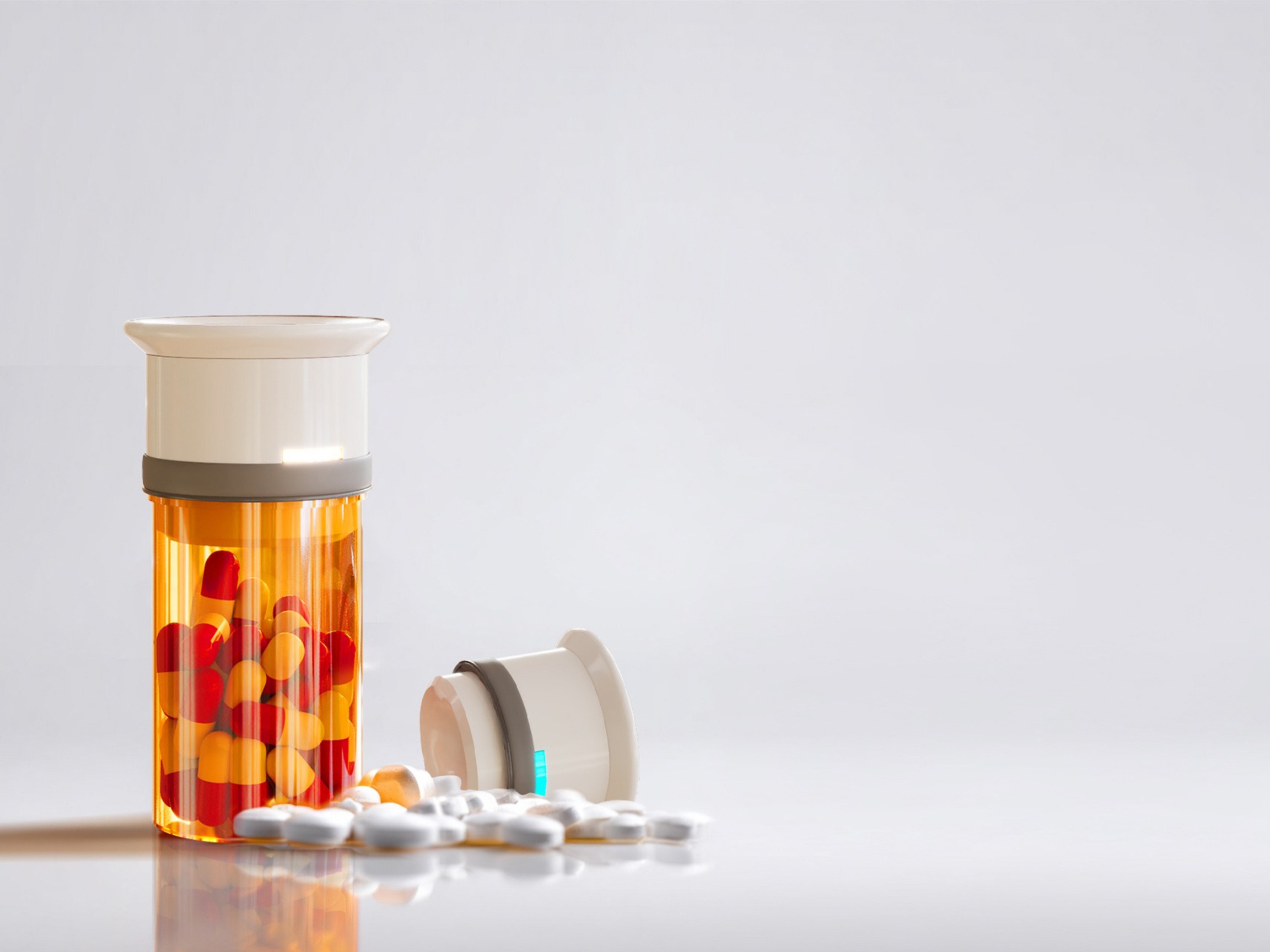
Dosage-Pal is a smart prescription pillbox lid designed to solve medication forgetfulness, repeated dosing, and drug abuse. Rather than redesigning the entire bottle, it shifts focus to the cap — the one universal component across all prescription containers — embedding gravity-triggered dispensing, an app-linked reminder system, and dose-record feedback into a single retrofittable device.
In the United States, prescription drug use should be a precise, safe, and regulated process — but reality reveals numerous loopholes: low self-discipline in medical adherence, no dose-timing tracking, and an escalating risk of overdose. Traditional medicine bottle designs have remained essentially unchanged for decades.
~50%
of patients with chronic conditions do not take medications as prescribed. (NCBI, 2022)
Self-report only
Current prescription bottles do not track dose timing — caregivers rely entirely on patient self-reporting, highly impairing dose adjustment. (FDA Medication Guide)
13,026 deaths
caused by prescription opioid overdose in 2023 alone — a 24-year escalating trend. (CDC Wonder)
These figures are not cold statistics, but real-life crises that have occurred countless times. Traditional medicine bottle designs have remained unchanged for decades and lack the ability to meet modern complex medication needs.
Questionnaire · 96 participants · ages 25+
I surveyed 96 individuals aged 25 and above who regularly take prescription medications, focusing on what they actually do when they forget a dose — a scenario the healthcare system largely treats as invisible.
Most Vulnerable User Groups
Elderly People
By Age Group
Chronic Illness Patients
By Condition
Opioid Medication Takers
By Prescription Type
Personas · 4 profiles
Zhong Li · 71 · Architect
Long work hours and frequent site visits make him forget or delay taking medication.
Shi · 65 · Retired Engineer
Struggles with remembering multiple medications for chronic conditions.
Ms. Li · 54 · Office Manager
Needs to track both her own and her parents' medications simultaneously, which can get confusing.
Xue Er · 43 · Freelance Photographer
Unstable travel routine causes missed doses and irregular adherence.
The traditional medication loop — hospital prescription → pharmacy → home — has no built-in feedback mechanism. Patients operate in isolation: no reminder, no record, no family or doctor visibility once the bottle leaves the pharmacy.
Six Failure Modes in the Existing Flow
- Forgetting to take medication
- Repeated / double dosing
- Taking the incorrect medication
- Improper medicine storage
- No dose-record mechanism
- Family and doctor unable to monitor remotely
Historical context · prescription bottle evolution
Apothecary Bottle
Glass with cork or wax seal. No standardisation.
Early Standardisation
Amber glass adopted. Paper instructions given separately.
Child-Resistant Cap
Push-and-turn caps mandated by law. Safety added, usability reduced.
Tech Experiments
Minimal changes despite rapidly evolving user needs and digital infrastructure.
Dosage-Pal's new connected loop
- 01APP sync at pharmacy handoff
- 02Sound + LED dose reminder
- 03Dose confirmed → record uploaded
- 04Feedback loop to family + doctor
Distribution: When dispensing new medications, the pharmacy hands the patient the bottle together with the Dosage-Pal cap. On the first fill, the pharmacist personally explains method of use, precautions, and app setup — keeping the intervention within existing pharmacy infrastructure.
Three engineering breakthroughs
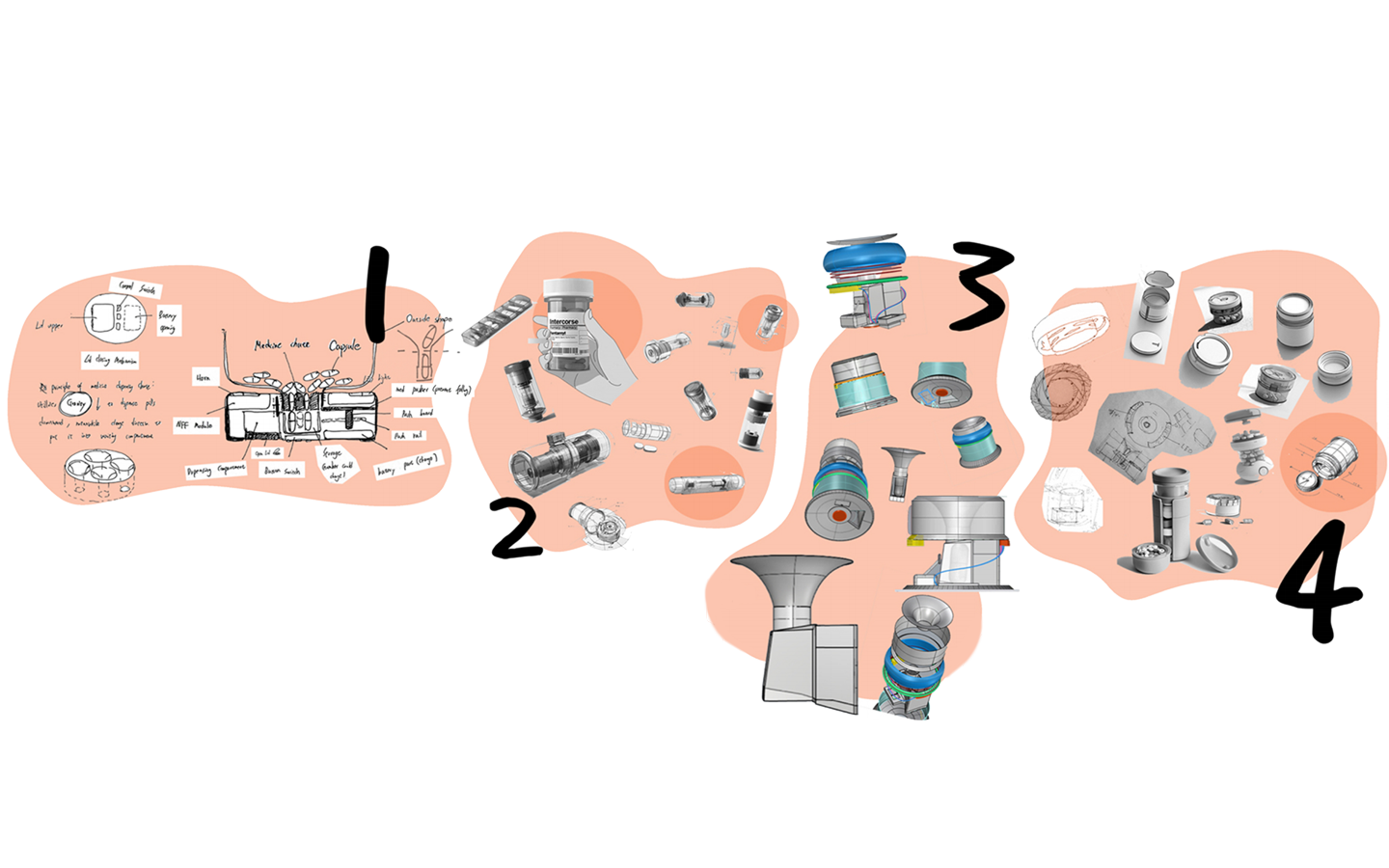
Gravity-Triggered Inverted Structure
Inverting the bottle releases exactly one capsule via gravity — no motor, no external force. Shifts the product story from bottle body to cap, eliminating jamming and unlocking new design possibilities.
Self-Adjusting Iris Diaphragm
A camera-inspired iris mechanism adapts from 5.5 cm to 5.0 cm, fitting virtually all standard prescription bottle mouths without any separate adapter or hardware modification.
Anti-Clogging Flat-Chute Funnel
Replacing the round inlet with a flat opening prevents pill stacking, ensuring smooth single-dose dispensing for both capsule and tablet form factors.
Dispensing process · 7 steps
Works identically for capsule and tablet variants. Step through the mechanism below.
1 / 7
Capsule falls into funnel channel
The app the cap talks to
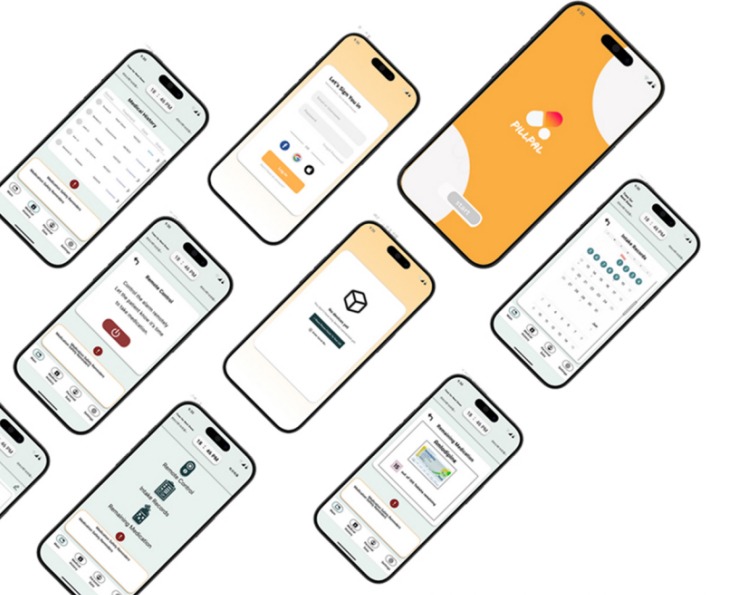
Designed for the worst morning
The person reaching for this is often tired, shaky, or squinting before their first coffee. Switch a condition on and compare a typical reminder with the Dosage-Pal card.
Metformin
500 mg
8:00 AM · with breakfast
Both work when nothing is wrong. That is the demo, not the morning.
A demonstration of the design principle — an illustration of why the choices were made, not measured test data.
"The bottle is the product."
"The cap is the intervention — retrofittable, universal, connected to the care loop."
The hardest constraint was also the most generative: the cap had to fit every existing bottle without requiring any changes to pharmacy infrastructure. Working within that constraint forced three mechanical breakthroughs — gravity dispensing, the iris diaphragm, and the flat-chute funnel — that wouldn't have emerged from a blank-slate redesign. The prescription bottle isn't a design failure. The missing layer was always the service around it.
Full PDF: